
Parenting Muslim Teenagers in the Digital Age: Faith, Identity, and the Screen in Between

In This Article
- ARTICLE
- December 23, 2025
- 10:01 am
For Muslim parents, raising teenagers has always involved balancing guidance with trust. In the digital age, maintaining that balance has become increasingly challenging. Phones and social media now sit between family life, faith, friendships, and identity, often shaping young people more quietly than parents realise.
Technology itself is not the problem. The challenge lies in how it draws attention, normalises values that clash with Islamic ethics, and places teenagers in spaces that reward exposure rather than character development. For Muslim families, this raises questions that go beyond screen time and into belief, behaviour, and belonging.
For many families, especially those exploring Islamic homeschooling or considering a Muslim online school, these questions are becoming central to how education, faith, and daily routines are shaped at home.
The challenge for Muslim parents today
Many Muslim parents’ sense that something has changed, even if they struggle to name it. Teenagers may still pray, attend classes, and appear outwardly fine, yet their inner world is being influenced by content that rarely reflects Islamic values.
Social media platforms promote constant self-display, comparison, and validation through likes and views. For Muslim teenagers, this can create tension between faith-based modesty and online norms that reward attention. Research involving Muslim families shows that young people often feel pressure to fit in online while also trying to preserve their religious identity, especially in non-Muslim majority societies.
Parents, meanwhile, often feel one step behind. Many report a digital gap where their children understand platforms better than they do, making monitoring feel difficult or ineffective.
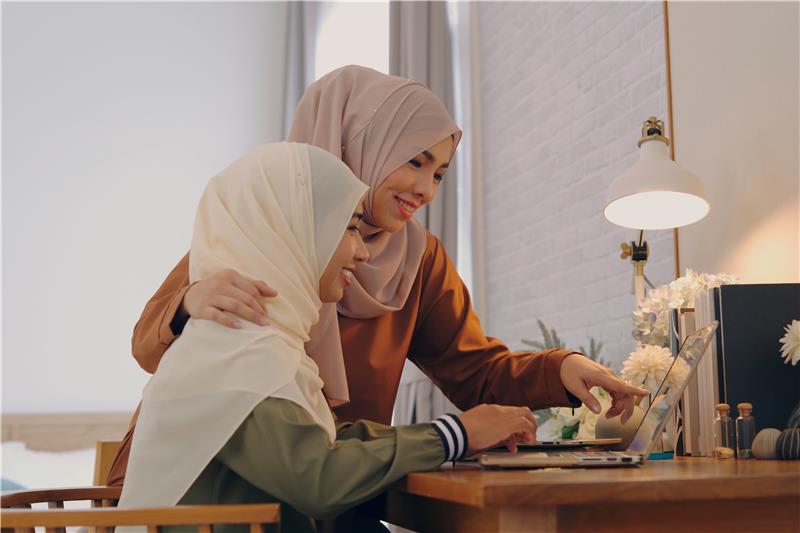
How Muslim Parents Can Plan for the Teenage Years
Reacting late is far harder than planning early. Muslim parenting in the digital age requires intentionality.
This begins with accepting that teenagers are not equipped to self-regulate their use of systems designed to keep them scrolling. Islam places responsibility on parents to guide, protect, and teach them gradually. That includes the online world.
Planning means:
- Setting clear expectations around phone use before habits harden.
- For families following an Islamic homeschool curriculum, these expectations can be woven directly into the school day, reinforcing consistency between learning, worship, and digital responsibility.
- Agreeing on family rules that link screen time to behaviour, sleep, and responsibilities
- Treating digital boundaries as part of Tarbiyah, not punishment
Studies involving Muslim families show that where parents combined boundaries with discussion rather than silence or force, teenagers were more willing to reflect on their own use over time.
Creating Safer Digital Opportunities Through Homeschooling

Homeschooling Muslim teenagers offers a unique advantage. Whether through Islamic homeschooling at home or enrolment in an Islamic online school, parents gain greater influence over daily routines, digital exposure, and values-based learning. For families in the UK, an online school in UK option that aligns with Islamic values can provide structure without sacrificing faith-based boundaries around technology.
Safer digital opportunities do not mean removing screens altogether. They mean:
- Separating learning devices from entertainment where possible
- Building offline anchors into the day, such as prayer, family meals, and physical activity
- Encouraging online spaces that support learning, creativity, or Islamic identity rather than endless scrolling
Research with Muslim young people has shown that prayer times and family activities naturally create technology-free breaks that teenagers themselves value, even if they struggle to maintain them alone.
Social media and the risk to Muslim identity

For many Muslim teenagers in the West, social media is where identity is tested most sharply. Online spaces can offer representation and connection, but they also expose young people to Islamophobic content, unrealistic lifestyles, and values that normalise immodesty, gossip, and constant comparison.
Muslim girls, in particular, report pressure around appearance and visibility online, including feeling underrepresented or judged for wearing hijab. Muslim boys describe pressure around success, status, and masculinity shaped by influencers rather than real-life role models.
Over time, this can weaken confidence in Islamic identity, replacing internal values with external approval.
Islamic guidance for Muslim teenagers
Islam offers clear principles that apply directly to digital life, even though the tools are modern.
Key teachings include:
- Haya (modesty): guiding what is shared, viewed, and said
- Amanah (trust): respecting privacy and avoiding exposure of self or others
- Avoidance of ghibah and harm: especially relevant in online comments, reposts, and group chats
- Accountability: remembering that words typed are still actions recorded
Islamic scholarship on social media ethics stresses that online behaviour is not separate from faith. The same standards apply whether speech is spoken or typed.
How Islam addresses screen addiction
Islam does not treat time as disposable. It teaches balance and restraint.
The principle of moderation encourages Muslims to avoid excess even in lawful things. Endless scrolling conflicts with this balance, especially when it distracts from prayer, family, study, or reflection.

Importantly, Islam already builds natural breaks into the day. Prayer, fasting, and intentional silence all interrupt constant stimulation. Research with Muslim teenagers found that many experienced greater calms and focus when phones were kept away during salah, even when they struggled to reduce usage elsewhere
This shows that faith-based routines can counter digital overload in a way that feels meaningful rather than forced.
What the Data Tells Us About Muslim Teenagers and Social Media

Qualitative studies involving Muslim families highlight several consistent patterns:
- Teenagers feel strongly attached to their phones and social platforms
- Many recognise overuse but feel unable to stop without support
- Parents worry about exposure, addiction, and loss of real-world engagement
- Both groups value faith-based pauses such as prayer and family time as moments of relief
These findings reinforce that the issue is not rebellion or laziness. It is immersion in systems designed to demand attention.
Positive take-home steps for Muslim parents
Muslim parents are not powerless in the digital age. Small, consistent actions matter more than perfect rules.
Practical steps include:
- Treating digital boundaries as part of Islamic upbringing, not control
- Keeping phones out of bedrooms at night to protect sleep and focus
- Linking screen freedom to responsibility and trust rather than arguments
- Using prayer times as natural screen breaks
- Talking openly about online pressures instead of avoiding the topic
Homeschooling parents can establish these habits as part of daily life from the outset, rather than having to correct them later.
A Final Reflection
Islam reminds us that attention, time, and actions are never neutral. They shape the heart long before they shape behaviour.
“And those who, when they spend, are neither excessive norstingy, but hold a middle course between the two.”
(Surah Al-Furqan 25:67)
Raising Muslim teenagers today requires more than teaching right and wrong. It requires helping them navigate a world that constantly pulls them away from reflection, restraint, and inner confidence.
Technology will continue to be a part of their lives. The goal is not isolation, but guidance. When faith shapes digital habits early, young people are better equipped to carry their identity with confidence, clarity, and self-control long after parental rules fade.
This article draws on a combination of peer-reviewed research, community-based studies with Muslim families, and Islamic ethical scholarship. In particular, it engages qualitative research examining how Muslim teenagers and parents experience social media, identity, and digital wellbeing, alongside studies on parenting, screen use, adolescent mental health, and Islamic perspectives on responsible technology use and online conduct.